
Alert adjudication is the critical success factor for financial crime compliance. Analysts must swiftly distinguish genuine risk from false positives while meeting operational and regulatory standards — yet the process across UK and European institutions is currently under question.
Screening systems are at risk of producing 90–95% false positive rates, costing an estimated $206 billion globally, with EMEA institutions accounting for nearly 40% more in related costs than North American counterparts. With a structural 0.75% signal-to-noise ratio, compliance teams are overwhelmed by benign transactions.
Regulatory pressure is mounting. The Anti-Money Laundering Authority (AMLA), launching in July 2026, will directly supervise major institutions and scrutinise adjudication quality. Alongside the European Banking Authority (EBA), Financial Conduct Authority (FCA), and EU AI Act, regulators now demand that adjudication decisions be consistent, traceable, and evidenced by authoritative data.
Sayari addresses this identity gap as a global Commercial World Model. By integrating 11.7 billion+ primary-source records via API, it enables automated entity resolution before alerts reach analysts. Deployments show a 70% reduction in false positives, alert resolution times dropping from 20 hours to under 2 minutes, and operational savings of 30–60%.
The Alert Adjudication Crisis: Scale, Cost, and Consequence
The alert adjudication crisis is a structural byproduct of screening systems. Traditional AML and KYC tools rely on name-matching heuristics that cannot distinguish between similar entities, leading to false positive rates of 90–95%. This costs the global financial system $206 billion annually, with EMEA institutions paying an outsize portion of the cost. Large firms can spend up to $671 million each year on these processes.
Labour drives 41% of compliance costs, with 72% of institutions reporting annual staffing increases, according to some reports. Investigating a single false alert takes roughly 30 minutes. For an institution with 10,000 daily alerts, noise consumes 4,750 analyst hours every day — the equivalent of an entire team dedicated to non-risk. This wastes over €113 million annually per institution.
The cost of noise
False alerts consume 30 minutes each. At 10,000 daily alerts and 90–95% false positives, 4,750 analyst hours are wasted daily, costing institutions over €113 million per year.
An “identity gap” sits at the root: systems flag every shared name without context like corporate affiliations or ownership structures. Manual research then drains time from genuine risk, resulting in a 0.75% signal-to-noise ratio where 19 of every 20 analyst hours are spent on noise.
The Signal-to-Noise Reality
| Metric | Before Sayari | After Sayari |
|---|---|---|
| Alert volume | 10,000 generated daily | Unchanged — Sayari acts upstream |
| False positives | 9,000–9,500 (90–95%) | ~2,500 (~25%) — 70% auto-resolved |
| Signal-to-noise ratio | 0.75% | ~40%: genuine risk surfaces clearly |
| Resolution time | ~20 hours per case | < 2 minutes via API auto-resolution |
| Annual cost of noise | €113M+ per institution | 30–60% reduction in operational cost |
| Analyst hours wasted | 1,733,750 hrs/year | Reallocated to genuine investigation |
AMLA and the New Supervisory Imperative
The launch of the Anti-Money Laundering Authority represents the most significant structural change to financial crime supervision in the European Union since the introduction of the Fourth Anti-Money Laundering Directive. For institutions operating in scope, its implications for alert adjudication programmes are direct and material.
What AMLA Is and Who It Supervises
AMLA, established by EU Regulation 2024/1620 and based in Frankfurt, starts supervision in July 2026. It directly oversees roughly 40 high-risk, cross-border “selected obliged entities” in banking, payments, and crypto services. Additionally, AMLA coordinates national supervisors to harmonise standards and intervene when local oversight is insufficient.
For direct supervision, AMLA acts as the lead AML/CFT authority with powers to inspect, request data, and issue binding decisions or sanctions up to 10% of turnover or €10 million. For others, it enforces a Common Supervisory Methodology (CSM) to ensure regulatory convergence between EU and UK authorities over time.
The Common Supervisory Methodology and Alert Adjudication
The CSM is the instrument through which AMLA will operationalise its supervisory expectations across EU Member States. It translates the principles of the AML Regulation (AMLR, EU 2024/1624) into specific examination criteria. For alert adjudication programmes, the CSM’s requirements fall into five areas that institutions should be assessing now.
| AMLA Supervisory Focus | Implication for Alert Adjudication Programmes |
|---|---|
| Alert disposition rationale | Every adjudication decision — whether an alert is escalated, auto-dismissed, or closed — must be supported by documented reasoning traceable to authoritative data sources. Subjective analyst judgements unsupported by provenance-backed evidence will not satisfy AMLA’s examination standard. |
| False positive management | Institutions must demonstrate they are actively managing false positive rates through systematic means, not merely accepting high volumes as an operational norm. Programmes that cannot evidence a structured approach to false positive reduction will be assessed as inadequate. |
| UBO and ownership transparency | Transaction monitoring outputs must incorporate beneficial ownership analysis. The AMLR’s requirements for UBO identification extend to counterparty screening, meaning that screening a name without resolving the ownership structure behind it is insufficient under the new framework. |
| Audit trail integrity | Every adjudication decision must carry an audit trail regulators can follow from alert trigger to outcome. The trail must link to primary-source data (sanctions lists, corporate registries, UBO filings) rather than to analyst notes or secondary aggregators. |
| AI and automated systems | Where institutions deploy AI-assisted adjudication, AMLA’s framework — consistent with the EU AI Act — requires that outputs be explainable and that data consumed by AI models be accurate, current, and traceable. “Black box” adjudication decisions will be a primary area of supervisory scrutiny. |
AMLA Direct Supervision: What in-scope institutions should expect
- On-site inspections with specific focus on transaction monitoring effectiveness and adjudication quality.
- Requests for alert volume data, disposition rates, and false positive metrics over rolling periods.
- Review of automated adjudication systems, including the data sources feeding AI models.
- Assessment of UBO identification capability across counterparty populations, not just clients.
- Testing of audit trail integrity: can every adjudication decision be traced to a primary-source record?
AMLA and the FCA: Convergent Expectations in a Divergent Framework
The United Kingdom’s departure from the EU means UK institutions are not subject to AMLA’s direct supervisory authority. However, the practical implications for UK-headquartered institutions with EU operations are significant, and the trajectory of FCA supervision indicates that regulatory demands are increasingly aligned.
UK institutions in AMLA’s directly supervised cohort (by virtue of their EU-domiciled subsidiaries or branches) will face AMLA examination alongside FCA oversight. The two regimes apply different legal instruments but share an increasingly common focus: adjudication quality, UBO transparency, and the defensibility of automated compliance decisions. The FCA’s own multi-firm reviews have consistently identified inadequate transaction monitoring calibration and insufficient counterparty intelligence as leading drivers of financial crime risk. Its 2025 Dear CEO letter to major banks reinforced the expectation that institutions demonstrate measurable improvement in alert quality, not merely the presence of monitoring systems.
For UK institutions operating exclusively domestically, the FCA regime remains the primary supervisory framework. Nonetheless, the CSM will increasingly serve as an international benchmark, and the FCA has historically aligned its own supervisory expectations with EBA guidelines. Institutions that can demonstrate AMLA-standard adjudication quality are well-positioned for FCA examination, even if they are not in AMLA’s direct supervisory scope.
6AMLD, AMLR, and the Legislative Foundation
AMLA’s oversight is built on a new legislative framework. The Sixth Anti-Money Laundering Directive (6AMLD) harmonises EU criminal law, while the AML Regulation (AMLR, EU 2024/1624) provides directly applicable rules for customer due diligence (CDD) and internal controls. By removing national discretions, the AMLR creates a unified standard for all institutions.
Specifically for alert adjudication, the AMLR mandates transaction monitoring calibration, counterparty due diligence for non-client payments, and beneficial owner identification during screening. These requirements are now legally enforceable by AMLA through its robust sanctioning powers.
Where Adjudication Breaks Down: Key Use Cases
Transaction Monitoring and Payment Screening
Transaction monitoring systems generate the majority of false positive volume. Sayari resolves non-client counterparty identities in outbound payment flows before alerts are generated, dramatically reducing noise from unknown beneficiaries — addressing a core EBA and AMLR requirement for screening non-client payment counterparties with beneficial ownership context.
Sanctions Screening
Common-name false positives are the primary driver of alert volume in EU and HM Treasury sanctions screening. Sayari resolves the core adjudication question: “Is this ‘Mohamed Ali’ the sanctioned individual, or one of 50,000 similarly named people?” by cross-referencing jurisdiction, corporate affiliations, and network proximity to known risks — with full provenance.
Customer Onboarding and KYC / CDD
Slow, labour-intensive onboarding generates compliance cost and friction for legitimate clients. Sayari’s pre-configured intelligence has driven 83% faster onboarding times in live deployments by eliminating manual data assembly, producing audit-ready onboarding documentation aligned to EBA CDD guidance.
Anti-Fraud
False positives in fraud detection block legitimate customers and erode trust. Sayari’s entity graph exposes shell company structures, manufactured identities, and layered corporate networks that distinguish genuine fraud risk from false hits — mapping the relationships rule-based systems miss entirely.
Enhanced Due Diligence
EDD is slow and resource-intensive when analysts manually compile ownership, affiliate, and adverse media data across systems. Sayari generates enriched entity profiles drawing on 11.7 billion+ records across 250+ jurisdictions, including UBO filings under the AMLA framework, reducing EDD turnaround whilst standardising output quality.
Correspondent Banking
Correspondent relationships generate disproportionate alert volume due to layered payment opacity. Sayari’s UBO graph surfaces indirect risk exposure including PEPs, SOE affiliations, sanctioned-entity adjacency, and high-risk jurisdiction routing — consistent with FATF Recommendation 13 and AMLA’s forthcoming framework for cross-border flows.
How Sayari Solves It: The Global Context Layer
The root cause of the false positive problem is an identity gap at the point of adjudication. Compliance screening systems cannot distinguish between similarly named entities because they lack the external context needed to resolve true identity in the moment an alert is generated. Sayari functions as a global context layer: a structured, authoritative intelligence layer that sits between the alert trigger and the analyst queue, resolving entity identity with substantiated precision rather than approximation. Sayari integrates via API into existing compliance workflows. No infrastructure replacement is required.
Sayari’s Commercial World Model draws on primary-source data from over 250 jurisdictions, including corporate registries, trade import/export records, sanctions lists, PEP databases, adverse media, and court records. The result is a 2-billion-relationship graph built on 11.7 billion+ authoritative records — including primary-source intelligence from UK Companies House, EU business registries, OFAC, and HM Treasury — structured for machine consumption and human review alike.
| Without Sayari | With Sayari |
|---|---|
| Name-only matching flags every phonetic or partial similarity. | Entity resolution maps corporate ownership, trade data, and registry records to confirm true identity. |
| A common name generates thousands of alerts, all requiring manual adjudication. | Cross-references jurisdiction, corporate affiliations, and network context to disambiguate at scale in seconds. |
| Shell company structures and beneficial owners are invisible at alert generation. | UBO graphs surface indirect exposure and nested corporate structures automatically, mapping through multiple layers. |
| Each alert requires ~20 hours of manual investigation across multiple systems. | API auto-resolution delivers a definitive adjudication answer in under 2 minutes, with full provenance chain. |
| Alert decisions are subjective and inconsistent across analyst teams. | Assessed intelligence standardises risk adjudication. Every decision is provenance-backed. |
| AI models trained on fragmented internal data fail. 80% of enterprise AI projects miss ROI targets. | Sayari provides the clean fuel AI needs: structured, machine-readable entity data with full lineage. |
| Regulatory audit requires reconstruction of fragmented analyst decisions. | Every adjudication decision is audit-ready by design, traceable to official government registries. |
Alert Adjudication in Practice: The Curzon Square Case
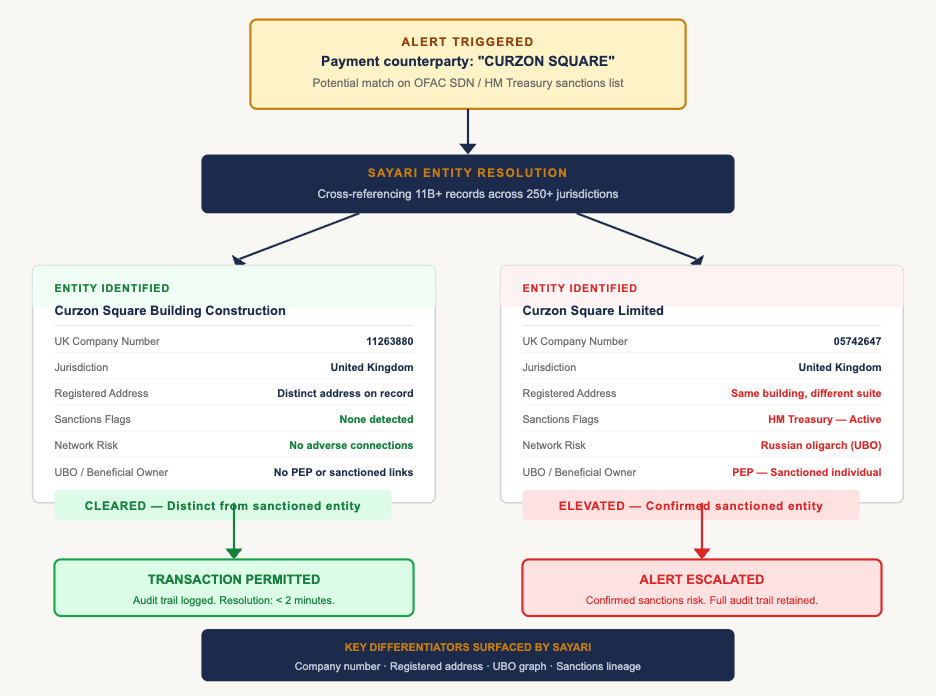
The following scenario illustrates how Sayari resolves a common-name false positive in real time. It draws on Sayari Graph data available at the point of publication and is presented as an example of the adjudication workflow Sayari enables.
The Alert
A payment instruction arrives naming “Curzon Square” as a beneficiary. The institution’s screening system generates an alert: a potential match on a sanctioned entity. Under a manual adjudication workflow, an analyst would now spend approximately 20 hours researching the counterparty across multiple systems before reaching a conclusion. That conclusion, in most cases, would be a false positive, with no audit trail robust enough to satisfy AMLA’s documentary requirements.
The Resolution
With Sayari, the adjudication runs in under 2 minutes. Querying the Commercial World Model by name and UK company number (11263880) returns a distinct entity: Curzon Square Building Construction. Its profile shows no sanctions flags, no PEP connections, and no adverse network adjacency. It is provably not the sanctioned entity. The finding traces directly to UK Companies House as the primary record.
The sanctioned entity, Curzon Square Limited (UK Company Number 05742647), is a separate company. It shares a name but diverges on every material identifier: distinct registration number, distinct address, and confirmed beneficial ownership ties to a Russian oligarch with an active HM Treasury designation. The designation is attached directly to the entity profile and traceable to its primary source.
What This Means Under AMLA
Under AMLA’s examination standard, the manual adjudication process fails on multiple counts. The 20-hour investigation timeline is incompatible with the operational throughput required at scale. The documentary record produced by manual research across disparate systems does not constitute a provenance chain traceable to a primary-source record. And without a systematic approach to false positive reduction, the institution cannot demonstrate “adequate procedures” under the AMLR’s transaction monitoring requirements.
The Sayari-enabled adjudication process satisfies each of these requirements. The determination is produced in under 2 minutes. It traces to UK Companies House as the primary registry record, to HM Treasury as the sanctions authority, and to the UBO graph as the beneficial ownership source. The full audit trail is logged automatically and is available for examination review without reconstruction. This is what AMLA will look for: not the presence of a monitoring system, but evidence that the system produces defensible, documented outcomes.
Case Study: The Compliance Cost Waterfall
The following scenario draws on published case studies of automated AML programmes at Tier-1 EMEA financial institutions and reflects actual implementation outcomes consistent with Sayari’s deployment experience.
Context
The institution was a representative Tier-1 European bank with cross-border payment flows spanning EMEA and Asia-Pacific, carrying an annual AML/KYC operational spend of approximately $731 million. False positive alert rates reached 95 to 98 per cent of total alerts generated. The compliance function was deploying labour equivalent in scale to a significant front-office division, with the primary cost driver being manual adjudication of alerts that confirmed no genuine threat.
Approach
The institution integrated Sayari’s Commercial World Model via API as a pre-screening entity resolution layer ahead of its existing transaction monitoring and sanctions screening workflow. Rather than replacing its compliance infrastructure, Sayari was positioned upstream: resolving entity identities on incoming alerts against 11.7 billion+ authoritative records from 250+ jurisdictions before alerts reached the analyst queue. Entities resolved as low-risk with high confidence were auto-adjudicated and dismissed, with full provenance-backed audit trail documentation retained for regulatory review.
Measured Outcomes
False positive rates fell from approximately 95 per cent to approximately 25 per cent. Alert resolution time dropped from a 20-hour manual adjudication process to under 2 minutes via API auto-resolution. Onboarding cycle times were reduced by 83 per cent. Regulatory audit outcomes also improved: every auto-adjudicated alert retained full data lineage traceable to official government registries, satisfying EBA Procedural Adequacy requirements and providing the audit trail AMLA will demand from 2026.
~$731M
Baseline annual cost
Representative Tier-1 institution
~$201M
Projected new cost
~$470M annual saving
30–60%
Total cost reduction
Industry-reported range
83%
Faster onboarding
Sayari-powered due diligence
| Metric | Before Sayari | After Sayari |
|---|---|---|
| False positive rate | ~95% | ~25% |
| Alert resolution | ~20 hours | < 2 minutes |
| Onboarding time | Baseline | 83% faster |
| Manual investigation | $731M+ p.a. | ~$240M reduction |
Sayari as “Clean Fuel” for Adjudication AI
European banks are investing billions in compliance AI, yet 80% of projects fail to deliver ROI due to poor data quality rather than flawed algorithms. Legacy systems create fragmented, siloed data that causes AI models to amplify biases and generate unreliable false positives. This “black box” issue is primarily a failure of data lineage.
Sayari provides the clean, structured, provenance-backed entity intelligence that turns compliance AI from a liability into a competitive advantage.
Sayari acts as “clean fuel” for AI, providing authoritative, machine-readable data from over 250 jurisdictions. This allows institutions to trace compliance decisions back to primary sources like UK Companies House and EU registries. Such transparency ensures AI outputs are defensible under the EU AI Act, BCBS 239, and EBA standards, while satisfying AMLA’s scrutiny of automated adjudication systems.
Regulatory Alignment: Meeting the AMLA Standard
The convergence of AMLA’s direct supervisory authority, the AMLR’s directly applicable legislative requirements, the EBA’s Procedural Adequacy standard, and the EU AI Act’s explainability obligations creates a unified benchmark against which adjudication programmes will be assessed from 2026. Institutions that cannot meet this benchmark face a combination of supervisory findings, mandatory remediation, and financial sanctions.
Sayari’s data lineage architecture directly addresses each dimension of this benchmark. Data flows from official government sources (UK Companies House, EU business registries, OFAC, HM Treasury, UBO filings under AMLA) through Sayari’s Commercial World Model into the institution’s compliance workflow. Every adjudication decision produced by that workflow is traceable to its source. That traceability is what AMLA’s examiners, EBA reviewers, and FCA supervisors will look for when they assess whether an institution’s adjudication programme is adequate.
What regulators will ask — and what Sayari enables
- AMLA: “Show us the evidence behind your auto-adjudicated alert dismissals.” → Every Sayari-resolved alert carries a full provenance chain to its primary-source record.
- EBA: “Demonstrate Procedural Adequacy in your counterparty screening.” → Sayari provides structured UBO and corporate registry data at point of alert, not retrospectively.
- FCA: “Evidence your transaction monitoring calibration and false positive management.” → 70% false positive reduction with documented methodology and measurable outcomes.
- EU AI Act: “Explain the outputs of your automated adjudication systems.” → Sayari-powered AI decisions trace to official government registries, not opaque model inference.
An institution that can demonstrate, during an AMLA on-site inspection, that its alert adjudication process produces outcomes in under 2 minutes, supported by provenance-backed audit trails traceable to primary-source records, and that its false positive rate has been reduced by 70 per cent through a systematic, documented approach, is in a materially stronger supervisory position than one relying on manual investigation supplemented by secondary data aggregators. The difference is not marginal. Under AMLA’s sanction regime, it is the difference between a clean examination and a remediation order.
Conclusion
The false positive problem is not a calibration issue that better rule-tuning can resolve. It is a data quality problem: name-matching systems do not have enough information about the entities they screen to distinguish genuine risk from legitimate activity at scale. Sayari solves this by supplying the external context that compliance infrastructure has always lacked — corporate ownership, beneficial ownership, trade relationships, and entity intelligence across 250+ jurisdictions, sourced directly from government registries, structured for machine consumption, and delivered via API integration that does not require replacing existing systems.
For Chief Compliance Officers and financial crime leaders facing AMLA supervision, EBA Procedural Adequacy requirements, and FCA effectiveness expectations, Sayari provides a concrete, measurable path: 70 per cent reduction in false positives. Alert resolution times from 20 hours to under 2 minutes. Operational cost reductions of 30 to 60 per cent. Onboarding 83 per cent faster. And compliance AI that satisfies AMLA, the EU AI Act, and BCBS 239 because its outputs trace back to authoritative source documents.
This blog is for informational purposes and isn’t intended to be legal advice.