

On April 15, 2026, the U.S. Department of the Treasury’s Office of Foreign Assets Control (OFAC) designated Iranian national Seyed Badroddin Naiemaei Moosavi, along with three of his front companies, for orchestrating a complex oil-for-gold money laundering scheme that generated hundreds of millions of dollars for Hezbollah and Iran’s Islamic Revolutionary Guard Corps–Qods Force (IRGC-QF). Prior to designation, Sayari had already traced significant portions of Moosavi’s broader network, identifying London property holdings, a web of companies across no fewer than five countries, and a circle of associates beyond the designation. The broader network could persist despite Moosavi’s designation.
This post walks through what Sayari found and what it means for compliance teams and government analysts working in the jurisdictions where this network is active.
The Designation: What OFAC Found
On April 15, 2026, in a joint action with Homeland Security Investigations (HSI), OFAC designated Moosavi under Executive Order 13224 for materially supporting Hezbollah. Simultaneously, OFAC designated three companies directly linked to him: Netherlands-based A.C.S. Global B.V. and UAE-based ACS Trading LLC and Lotus Universal LLC, each for being owned, controlled, or directed by Moosavi in support of Hezbollah operations.
According to Treasury, Moosavi facilitated the sale of Iranian oil in exchange for Venezuelan gold — a scheme designed to bypass Western financial sanctions and funnel proceeds to Hezbollah and the IRGC-QF, with assistance from individuals tied to the former Maduro regime. A further connection to Turkey illustrates how the network leveraged intermediary jurisdictions to launder value across multiple legs of the transaction. The scheme was resilient by design: Moosavi is reported to have stepped into the role following the 2020 arrest of a Hezbollah financier, demonstrating the network’s capacity to absorb disruption and reconstitute around new operators.
His operational footprint spans Dubai, London, and Istanbul — a reach corroborated by open-source reporting as early as 2022 that identified Moosavi as a key facilitator in the IRGC’s movement of gold from Venezuela to Iran. His designated companies were incorporated in the Netherlands and the UAE. Assets Sayari identified prior to the designation — including properties in London and dormant corporate links to UK-registered entities — represent the kind of holdings that name-only screening programs might miss entirely.
What Sayari Found: London Properties and Additional Associates
Beginning in 2025, Sayari analysts traced Moosavi’s corporate ecosystem using Sayari’s Graph platform and Commercial World Model, a digital twin of global commerce built on more than 11 billion primary-source records worldwide. What emerged was a network far more extensive than initially suspected.
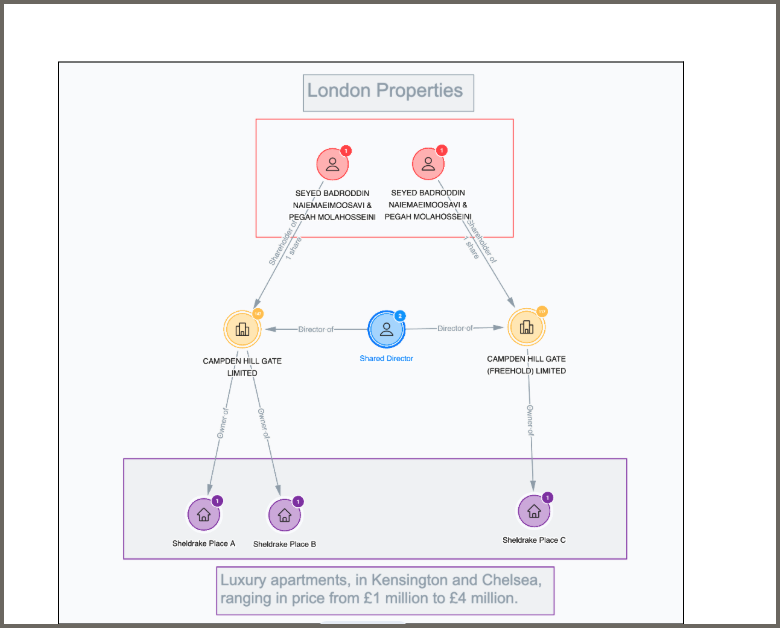
Records accessed via Sayari Graph linked Moosavi to an individual named Pegah Mola Hosseini. Together with Moosavi, the two are shareholders in at least two London-based property companies: Campden Hill Gate Limited and Campden Hill Gate (Freehold) Limited. While Moosavi and Hosseini hold only minority stakes in these companies, their shares relate to the freeholds of associated properties — an interest that nonetheless could represent millions of pounds in value. According to filings from UK Companies House, viewable directly within Sayari Graph, both companies manage properties in West London valued at millions of pounds sterling.
Pegah Mola Hosseini is also identified in Iranian corporate registry data (including the official Iranian Rooznameh Gazette and company registration filings) as the chairman of the board of directors of Iran-based Golden Shrimp Company (شرکت میگو طلایی). Golden Shrimp’s broader corporate network includes individuals bearing a variation of the Molla Hosseini name, suggesting a potential family network, as well as a former auditor who potentially shares a variant of Moosavi’s family name: Seyed Shahabuddin Naeimaei Mousavi.
An additional individual, Pouya Pourrankooh, serves as substitute inspector for Golden Shrimp and is a partner in an Iranian engineering consultancy where Seyed Shahabuddin Naeimaei Mousavi is a director. Pourrankooh effectively functions as a bridge between the Molla Hosseini network and the Naeimaei Mousavi network — corroborating the relationship between Pegah Mola Hosseini and Badroddin Moosavi through a secondary chain of documented corporate associations. A further connection between the two runs through an Iranian registered entity called You Are An Idea Processing Company (شرکت ایده پردازان هستی) (also rendered in translation as “Idea Makers Company”), which appears in Sayari Graph as a shared association between Moosavi and Mola Hosseini. Tracing that entity’s network downstream surfaces a connection to Hezbollah, corroborated by OFAC’s own designation records for Moosavi, which are indexed within Sayari Graph alongside the primary-source Iranian corporate data.
A Network Built on Naming Conventions
Experienced financial crime and sanctions investigators know that serial sanctions evaders rarely operate through a single corporate identity. They typically build portfolios. Sometimes, these ostensibly licit entities can share naming conventions across jurisdictions — allowing for plausible deniability while maintaining operational coherence.
Moosavi is no exception. Sayari’s analysis identified two distinct naming conventions he employs across multiple countries.
“ACS” — After the OFAC-designated Netherlands entity A.C.S. Global B.V. (where Moosavi is listed as a director in Dutch corporate records), the same convention appears in the UAE as ACS Trading LLC, a company OFAC designated in April 2026 as directly connected to Moosavi.
“Lotus” — Sayari identified this second naming convention through Moosavi’s former directorships in two now-dissolved UK companies: Lotus Universal UK Limited (closed January 9, 2024) and Lotus Metals Ltd. The Lotus convention also appears in the UAE as Lotus Universal LLC, designated by OFAC in April 2026. The Lotus entities span three jurisdictions. Two are now designated. The UK entities are closed. But the individuals who moved through them may not be.
The Homayoon Behnam Trail: £4.7 Million in Assets
The Lotus Metals Ltd thread surfaced another individual of note: Homayoon Behnam, who served as a director of Lotus Metals alongside Moosavi. UK corporate records show that Behnam subsequently became the majority shareholder of Glen Resources Holdings Ltd., a UK-registered company with assets valued at approximately £4.7 million.
Glen Resources Holdings Ltd. appears to have been established shortly after the dissolution of Behnam’s Cypriot company Red Arch Limited, which shares a former corporate name with Glen Resources Holdings. Closure of a Cypriot entity, followed by the immediate registration of a UK entity with overlapping identity, has suggested asset migration to avoid scrutiny in other contexts.
While Homayoon Behnam’s precise associations with Moosavi are unclear, their proximity is noteworthy. Behnam and Glen Resources Holdings Ltd. are traceable through documented corporate relationships to a now-designated SDN, through a chain of UK, Cypriot, and Iranian records that Sayari was able to surface, link, and present in a single investigative workflow.
What This Means for Compliance Teams
The broader lesson from the Moosavi case is one that the anti-financial crime community has encountered before. When a predecessor financier was arrested in 2020, the network that financier had built did not collapse. It adapted, and Moosavi reportedly stepped into an operational role. The network that Moosavi built will very likely do the same. As legal analysts and financial industry observers have noted, Treasury’s “Economic Fury” campaign is escalating pressure on Iranian financing networks — but what is attributed to Moosavi today may already be transitioning to another facilitator, through entities and individuals who do not yet appear on any watchlist.
Sanctions screening against the SDN list is the floor, not the ceiling, of effective compliance. Compliance teams and government analysts who want to move beyond list-checking and into network-level risk assessment can request a demonstration of Sayari Graph at sayari.com/demo.
The findings presented here are preliminary, based on data as it appears in original government and trade databases, and are not meant to constitute legal advice. Additional due diligence is recommended to confirm findings and supplement research.