
Supply Chain Risk
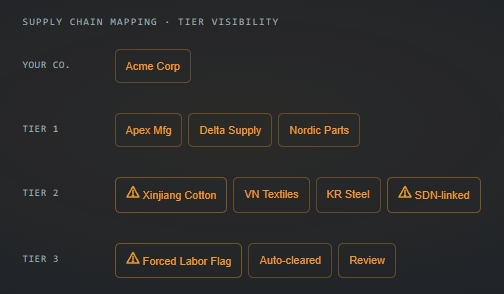
Risk doesn’t stop at Tier 1. Neither should visibility.
Self-reported supplier questionnaires don’t reveal sub-tier supplier exposure, forced labor risk, or ownership by sanctioned parties. Sayari independently verifies the full supply chain network – from tier-1 to tier-N – using 4B+ trade transactions and 500M+ entity profiles.
4B+
Trade transactions
500M+
Entity profiles
250+
Jurisdictions
10×
Faster than manual review
65%
Enterprises need deeper supply chain visibility
of enterprises say they need better supply chain visibility beyond Tier 1. The risk lives in sub-tier suppliers, transshipment nodes, and beneficial owners that current tools don’t reach.
Source: Sayari Global Executive Survey, 2025
The supply chain risk problem
The exposure is always in the tier you can’t see.
Most companies have good visibility into their tier-1 suppliers. They have almost no visibility into tier-2 and tier-3. And that’s exactly where forced labor, sanctions exposure, and state-owned enterprise ties tend to surface.
UFLPA import holds. CBP detentions. OFAC enforcement. The common factor: compliance teams that were relying on supplier self-certification rather than independent verification of the actual supply chain network.
Sub-tier visibility gap
Tier-1 questionnaires don’t reveal who your tier-1 is buying from. Forced labor risk and sanctions exposure concentrate at tier-2 and below.
Self-certification is unverifiable
Suppliers have every incentive to certify compliance. They have no obligation to accurately report their own supply chains. Sayari verifies independently.
Trade data alone isn’t enough
Knowing a shipment came from Vietnam doesn’t tell you which factory, who owns it, or whether that factory sources from Xinjiang. Ownership data completes the picture.
Enforcement is accelerating
CBP UFLPA detentions increased 300%+ in the first year of enforcement. OFAC is actively pursuing companies with indirect sanctions exposure through supply chains.
What Sayari does
Independent verification. Not another questionnaire.
Trade-based supplier mapping
Sayari’s 4B+ trade transactions map your actual supplier network – who’s shipping to whom – independent of what anyone self-reports.
Factory and facility identification
Identify the specific facilities in your supply chain and verify their ownership, certifications, and prior enforcement history.
Forced labor risk screening
Cross-reference supply chain nodes against UFLPA Entity List, CBP forced labor findings, and geographic risk indicators for Xinjiang and other high-risk regions.
Ownership and control verification
Verify who actually owns your key suppliers – including state-owned enterprise ties and sanctioned party beneficial ownership through the full corporate chain.
Portfolio-wide risk scoring
Score your entire supplier portfolio simultaneously – prioritize which relationships require deeper investigation before an import hold or audit.
Audit-ready documentation
Source-cited evidence packages for every supplier determination – ready for CBP audit responses, board reporting, or regulatory inquiry.
Regulatory coverage
The supply chain compliance frameworks Sayari supports.
UFLPA (2022)
Uyghur Forced Labor Prevention Act – rebuttable presumption for goods with Xinjiang nexus entering the U.S.
EU Supply Chain Act
Corporate Sustainability Due Diligence Directive – mandatory human rights and environmental due diligence for EU companies and their value chains.
German LkSG
Lieferkettensorgfaltspflichtengesetz – German Supply Chain Due Diligence Act, requiring documented risk analysis across supply chains.
UK Modern Slavery Act
Annual transparency statement requirement for large businesses covering forced labor risk in supply chains and operations.
OFAC Supply Chain
OFAC enforcement via supply chain exposure – indirect sanctions violations through suppliers, sub-suppliers, and trade counterparties.
CBP Withhold Release Orders
Section 307 of the Tariff Act – CBP withhold release orders for goods produced with forced labor anywhere in the supply chain.
FAQ
Common questions about supply chain risk
4B+
Trade transactions for
independent supply chain mapping
10×
Faster than manual
third-party due diligence
250+
Jurisdictions with
supplier entity coverage
Map your actual supply chain.
Request a demo. We’ll run Sayari’s trade-based supplier mapping against your key suppliers and show you what’s in your tier-2 and tier-3 that questionnaires don’t reveal.